Fixed-point method in plasma loaded helical waveguide problems
K. Kanjevac, V. Babović i M. Kovačević · SPIG 2004. · 2004
K. Kanjevac, V. Babović, M. Kovačević
Faculty of Natural Sciences, Physics Department,
R. Domanovića 12; vukot@kg.ac.yu
Abstract. Applying the fixed-point method of computations we improved the existing numerical results, and actually those related to the dispersion equations and the characteristic impedances. The functions involved have the convenient form to enable relatively rapid convergence.
iNTRODUCTION
The propagation of electromagnetic waves along various guiding surfaces appears to be an important research topic for generations of scientists and engineers. Composite lines supporting the propagation have more or less sophisticated structure which may include dielectric layers combined with classical elements such as highly conducting lining, wire coil and so on. Of course, plasma as a peculiar medium often is in the focus in such problems. Experiments are performed mostly in cylindrical geometry whereas corresponding theories supply analytical results for a number of other geometries, including some rather exotical.
The last decade was specific for the rapid development of computer technologies and efficient software packages used in analyses of scientific and engineering projects. The physicists have thus gained the advantageousness to raise in their work the quality and fastness, which formerly was inapproachable. In the realm we here treat it is quite evident.
We have already observed it could be helpful if one numerically treats dispersion relation, efficiency of excitation, characteristic impedance and many other physical quantity related to the guided plasma waves via the fixed-point method. Some starting ideas of the kind are to be found in the book [1]. More about the feasibility of the method the reader can find in [2]. In this paper we employ the fixed-point method in a recently investigated problem, and actually that of plasma loaded helical waveguide; we will attempt to overcome the numerical difficulties, which the complex expressions infer, avoiding the simplifications adopted in [3]. At the same time, we are going to estimate the uncertainties, which could be introduced by mere applying of the quasi-static approximation.
PLASMA LOADED HELICAL WAVEGUIDE
For the convenience of reading we will now quote some expressions that follow from the theory of the axially symmetric propagation of electromagnetic waves along the plasma loaded helical waveguide. The full explanation of the physical model and the mathematical procedure can be found in [3] and will be here omitted.
Dispersion Relation of Waves on a Plasma Loaded Screened Coil
Consider the propagation of waves along a coil, the interior of which is filled with homogeneous plasma, the radius being . The coil is in a metallic cylinder, radius of which is denoted by . Between coil and outer metallic sheet there is a dielectric of permittivity . The dispersion equation can be put in the form
Here, and are the normalized radian wave frequency and plasma frequency, respectively. The understanding of the above equation requires a set of additional expressions:
Functions are the modified Bessel function of the first kind of order and the modified Bessel functions of the second kind of order ; stands for the wavenumber, and is the velocity of light.
Characteristic Impedance of the Plasma Loaded Helical Waveguide
Let us now explain the expression for the characteristic impedance which reads
The pitch angle of the helix is and holds . The meanings of the abbreviations and are as follows (note that we use ):
Above, we have inserted and . Unfortunately, the equation (41) in [3], because of a tedious printing error is not identical with our expression (6) for the characteristic impedance.
EVALUATIONS ACCORDING TO FIXED-POINT METHOD
We shall now present some of the results obtained from equations (1) and (6) by the fixed-point method. First in the figure 1 we see a typical dispersion diagram for the hybrid coil-plasma mode.
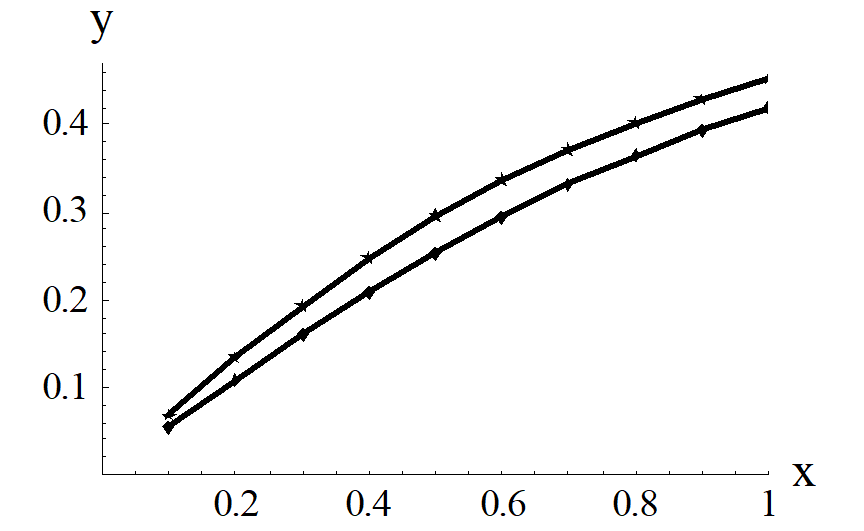
Figure 1. Dispersion diagram for hybrid coil-plasma mode
The parameters are taken as follows: , , and .
The upper curve relies upon the quasi-static approximation. If the parameter of electron density grows, it will enhance the difference between the two computations.
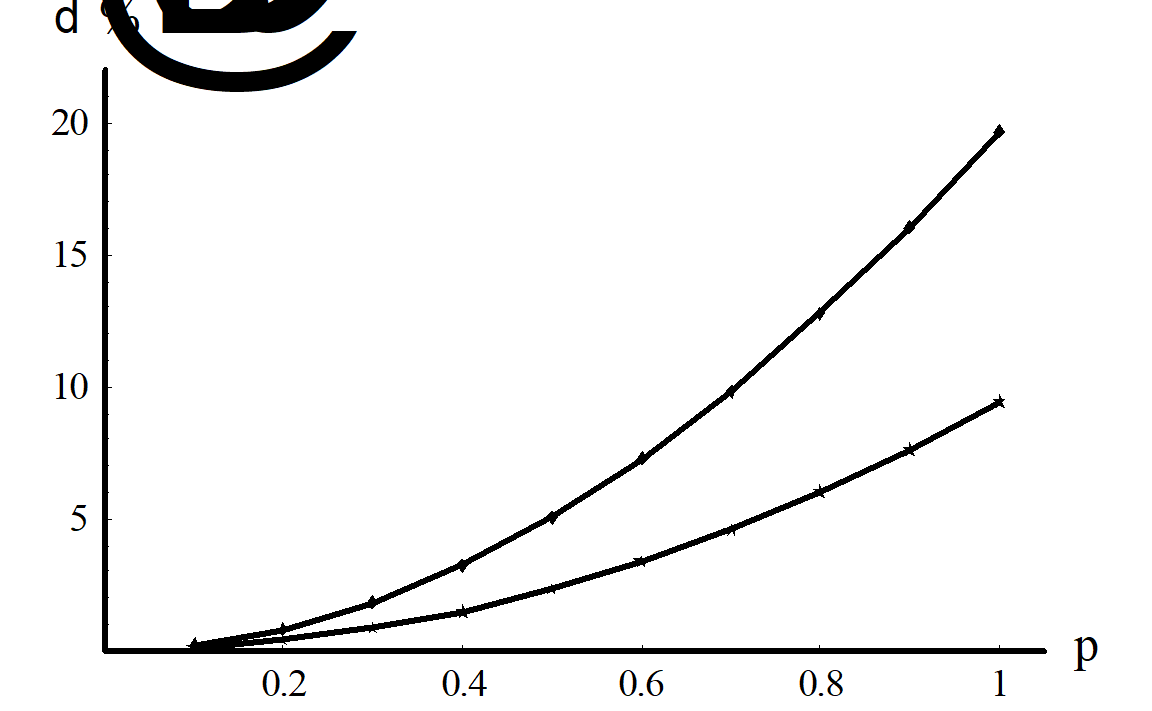
Figure 2. The enhance of the error when the density parameter grows
This effect is illustrated on the figure 2; two curves are presented: for (up) and (down). The dependence of on the wavenumber typically is as shown on the figure 3. As expected, the error rapidly decays with the wavenumber’s growth; note that the upper curve is drawn for and the lower for .
Let us now see one example of the computations concerning the characteristic impedance. Our figure 4 shows the error, which one makes if performing computations of characteristic impedance in the frame of the quasi-static approximation, as compared with the fixed-point method results. The set of applied parameters is as follows: , , ; the parameter of the electron plasma density is for the upper curve and for the lower curve. The error monotonically decreases with growing values of normalized wavenumbers; it is nowhere greater than nearly ten percents and reaches the negligible values (not 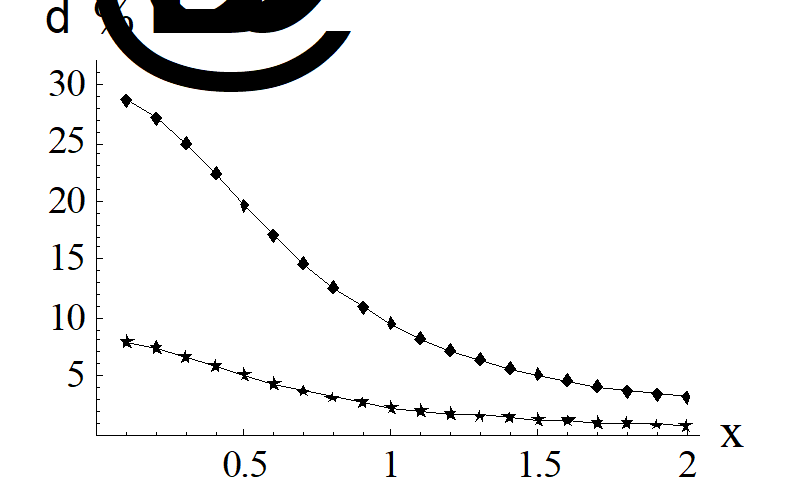 exceeding one percent) if satisfied as well as .
Figure 3. Error level as a function of wavenumber estimates the reliability of the approximate method for dispersion equations computations; electron density parameter 0.3 (down) and 0.5 (up).
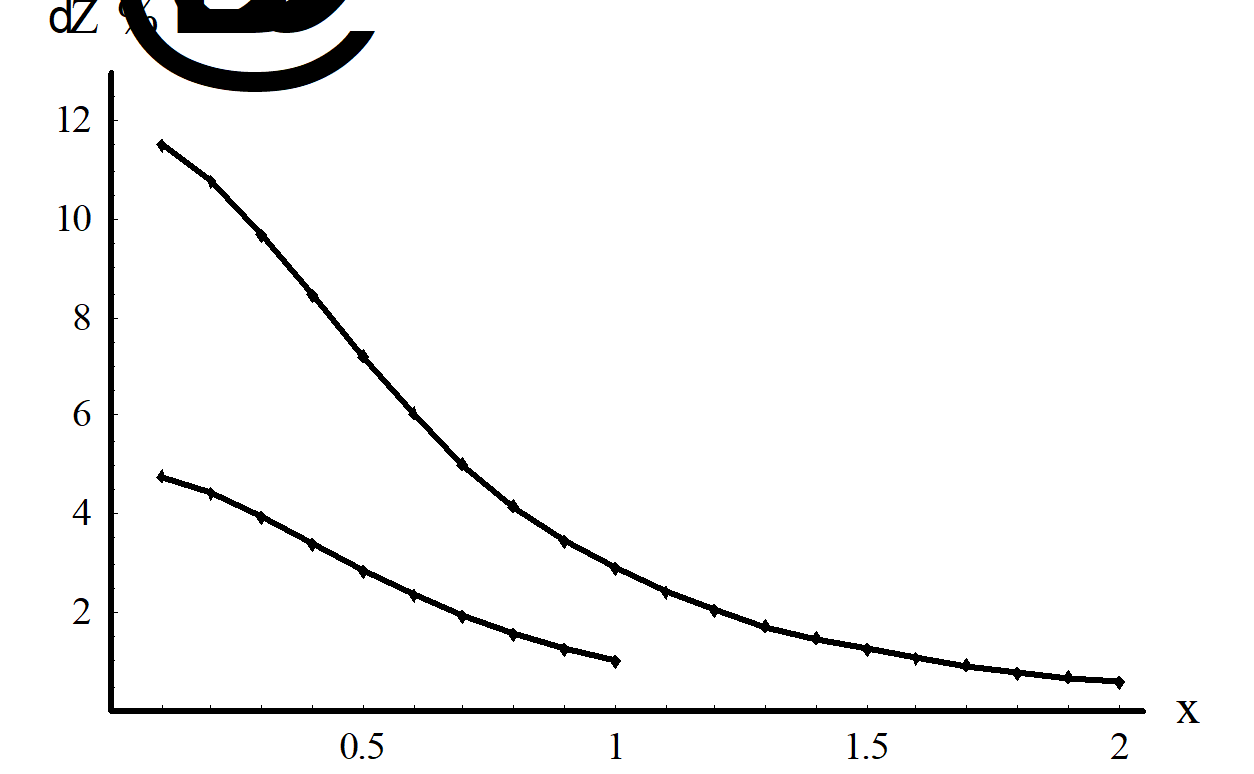
Figure 4. Reliability of the approximate method for impedance computations: error level as a function of wavenumber; electron density parameter 0.3 (down) and 0.5 (up).
CONCLUSION
A broad class of physical problems related to the propagation of electromagnetic waves along various guiding structures which include dielectrics, metals and plasma media can be numerically treat in a rather efficient way by the means of the fixed-point method. As proved, the surface function of such composite structures is of favorable form to secure the rapid convergence of the iteration procedure. Ones more we have tested the method in plasma loaded helical waveguide problems, where we have examined the character of limitations introduced by various approximations.
References
1. Babovic, Vukota, “Eksitacija površinskih elektronskih talasa u plazmi”, Kragujevac, Prirodno-matematički fakultet, 1999.
2. Babović, V., and Kovačević, M., Journal of Research in Physics, 29, No 1, 5-12 (2002).
3. Aničin, B. A., J. Phys. D: Appl. Phys., 33, 1-6 (2000).